Websites affiliated with U.S. broadcaster NBC were hacked for several hours on Thursday, serving up malicious software intended to steal bank account details.
On its own technology blog, NBC released a statement saying, “We’ve identified the problem and are working to resolve it. No user information has been compromised.”
Sites such as NBC.com are a frequent target for hackers since the high volume of visitors offers a chance to infect many people in a short period of time.
Facebook and Google blocked access to NBC.com after it was found on Thursday serving up malicious software intended to steal bank account details.
Several computer security companies said the main NBC.com website had been modified to serve up an iframe, which is a way to load content into a website from another domain.
The iframe loaded an exploit kit called Redkit, which tries to see if a visitor is running unpatched software, according to a blog post from Securi, a computer security company based in Menifee, California. The style of attack is known as a drive-by download and can infect a computer when a user merely views a website.
NBC.com was temporarily blacklisted by Google after the attack. Facebook also stopped directing users to NBC.com. Securi wrote that other NBC sites, including ones for TV talk show hosts Jimmy Fallon and Jay Leno, were also affected.
The hack follows the release of a report this week from security vendor Mandiant about a long-running hacking campaign allegedly based in Shanghai that targeted U.S. corporations, although it did not immediately appear connected with the problems at NBC.com.
Another computer security firm, SurfRight, wrote on its HitmanPro blog that the NBC attack loaded exploits that look for vulnerabilities in Oracle’s Java programming framework and Adobe’s PDF products. Oracle and Adobe have both released critical updates for their products this month, but hackers hope to hit users who have not updated their computers.
If the attack is successful, one of two malicious software programs is delivered, called Citadel or ZeroAccess. Citadel is a trojan designed to collect account credentials for banks including Bank of America, Wells Fargo, Chase and others, according to Fox-IT, a Dutch computer forensics company.
The version of Citadel analyzed by Fox-IT showed it was being detected by only three of 46 products on VirusTotal, a website where malicious software can be tested for detection against many of the popular security suites.
According to Symantec, ZeroAccess is an advanced rootkit, or a piece of malicious software that hides at a low level in a computer’s operating system. ZeroAccess, detected by Symantec in July 2011, can create its own hidden file system and download other malware to a computer.
A smart TV is only as smart as the person controlling it. So if the person in control is a hacker, the owner could have a problem. Researchers at security consultancy ReVuln say some smart TVs are vulnerable to hacking.
It is another example of what experts say is the ever-expanding attack surface of devices that traditionally never faced the Internet, but are now "smart."
The researchers at the Malta-based company said they found a vulnerability in a number of smart TVs made by Samsung Electronics that gave them root access to the TV and any attached USB drives.
They posted a video titled "The TV is Watching You," which appears on a number of security vendor websites, including Kasperky Lab's Threatpost. While there is no voiceover, the video shows the researchers accessing the TV settings and channel lists, SecureStorage accounts, widgets and their configurations, the history of USB movies, the ID, firmware, whole partitions and any attached USB drives.
They were also able to retrieve the drive image, mount it locally and check for information like usernames, passwords, financial documents, or any other type of material on USB drives.
"The vulnerability affects multiple models and generations of the devices produced by this vendor, so not just a specific model as tested in our lab at ReVuln," the report said.
Samsung did not respond to a request for comment, but ReVuln emailed a statement saying there is no firmware update yet, "as the details regarding this vulnerability have not been shared with the vendor."
The statement added that ReVuln has only tested Samsung, but said: "We think that other brands of TV may be affected by similar issues."
James Arlen, senior security consultant with Leviathan Security Group and a hacking expert, said the TV is just one example of the "Internet of Things" and other non-computer resources in homes that amount to "a huge new attack surface."
"I recently counted the number of IP addresses in my house and came up with all kinds of new things that require Internet access - not just the computers, game systems, tablets and music players, but also the bathroom scale, the thermostat and more," he said. "Televisions are one of many, but also the most likely to have lots of interconnection possibilities."
He said the problem is not new, noting that, "printers got smarter and became a threat," and that the number of smart devices continues to expand.
Dan Frye, general manager of services at MAD Security, agrees. "A common way to get into enterprise networks is through printers attached to the corporate network. A TV on the corporate net is really the same thing," he said. "In essence, you've got a computer inside some device, whether it be a printer, a TV, a toaster, the Coke machine, etc., and that computer is just as vulnerable to attacks as a normal computer would be."
"Any new piece of technology that connects to the Internet is a probable attack surface," said Matt Johansen, WhiteHat Security threat research manager. "Look at the recent research by Barnaby Jack about insulin pumps and pacemakers."
"Who would have thought these devices would ever be susceptible to hackers?" Johansen said. "But if a hacker gets their hands on any device long enough, they'll figure out a way to break it. It was hotel door locks, slot machines in the past and it will be the smart toasters and refrigerators in the future."
Gary McGraw, CTO of Cigital, said most people don't think of their TV or other household devices as computers, but they are. "Your TV is just a computer with a monitor," he said. "And it knows a lot about you—what you've watched, whether you were home at the time."
There is some disagreement over how much of a priority security is for devices that have only recently begun to face the Internet. "Focus on delivering the product to market means that the 'Ship It' award is more important than 'Is it Hackable?'" Arlen said.
Frye agrees that security standards for such devices are "immature." But he said vulnerabilities are found "everywhere, all the time, in products that certainly take security into account. Microsoft, Google, and Apple are all great examples."
McGraw said while the vulnerability discovered by ReVuln is real, he doesn't think Samsung is necessarily lax on security. "They make the most popular Android phone out there," he said. "So they are in the [security] wars."
To deal with the ongoing threats, both consumers and enterprises need to "control your exit path," Arlen said. "Most consumers are unaware of what traffic passes in or out of their primary systems, so they're going to be even more unaware of the traffic to and from devices that are 'furniture' rather than computers."
"More manufacturers across lots of industries need to employ or engage with the "hacker-ish" community to solve the problems prior to the shipping of the product," he added.
Frye said that once products are released, manufacturers need to treat them like computers, and "have a way for people to report vulnerabilities and a way for patches to be deployed out to their consumers."
Samsung's bug bounty
Samsung has begun treating smart devices like computers. "Samsung has actually taken a step in a great direction with a TV bug bounty program for researchers to submit bugs to receive a reward ($1,000), which has been useful for the likes of Google, Facebook, Mozilla, and even PayPal," Johansen said.
However, every computing device is potentially vulnerable, and with "The Internet of Everything" there will be more of them all the time. "This problem will only get worse as we integrate more things into our home networks," Frye said. "It's the TV now, but smart devices, smart meters for our power, the toaster, thermostat—they're all at risk in the same way."
Twitter’s servers have been breached by “extremely sophisticated” hackers who may have made off with user names and passwords for about 250,000 users, the company said Friday.
Twitter said unusual access patterns led it to identify the attacks, which took place during the past week.
“We discovered one live attack and were able to shut it down in process moments later. However, our investigation has thus far indicated that the attackers may have had access to limited user information—usernames, email addresses, session tokens and encrypted/salted versions of passwords—for approximately 250,000 users,” Twitter Director of Information Security Bob Lord said in a blog post.
Twitter reset the passwords and revoked session tokens for the accounts, and said it was emailing the affected users Friday and telling them to reset their passwords.
“This attack was not the work of amateurs, and we do not believe it was an isolated incident,” the company said in its post.
It noted that The New York Times and The Wall Street Journalalso said they’d beentargeted by hackers this week. Those companies said the attacks originated in China, but Twitter did not point to a country of origin.
Twitter said it thinks other companies and organizations have recently been similarly attacked.
It urged all its users to ensure they are using strong passwords on Twitter and elsewhere on the Internet. Passwords should be at least 10 characters and use a mix of upper- and lowercase letters, as well as numbers and symbols, the site said.
“Using the same password for multiple online accounts significantly increases your odds of being compromised,” Twitter said. “If you are not using good password hygiene, take a moment now to change your Twitter passwords.”
The company said it was still gathering information about the attacks and is working with federal law enforcement agencies to prosecute the attackers.
With HTML5 and the Canvas 2D specifications now "feature-complete," the W3C (World Wide Web Consortium) is mapping out enhancements for subsequent versions of these technologies.
Features under consideration for HTML5.1, though not necessarily mentioned in the first draft, include improvements to video captioning and fast seeking; better forms, including input modes and autocomplete; spell checking; better image accessibility; and more powerful iframes, for embedding documents, a W3C representative said. One intention for Canvas 2D Level 2, meanwhile, is that it would work better on high-resolution displays.
W3C hopes to finalize HTML5.1 as an official "W3C Recommendation" in 2016; no date is set yet for finalizing Canvas 2D Level 2. Final adoption of HTML5 as an W3C Recommendations, meanwhile, is anticipated in 2014. Canvas 2D could become official in 2013.
One issue that continues to be a thorn in the side for HTML5 is the lack a standard video codec, with W3C not having found a suitable one that meets the organization's royalty-free requirements. The organization has considered such codecs as H.264 and Google's VP8, which Google said is in fact royalty-free. H.264 is administered by patent pool packager MPEG LA. "It is my view that it would be desirable for MPEG LA to make [patents pertaining to H.264] available on a royalty-free basis," W3C CEO Jeff Jaffe said. MPEG LA offers H.264 royalty-free only in certain cases.
Moving HTML5 to feature-completeness was viewed as one milestone of many and important in marching the Web platform forward, analyst Al Hilwa, of IDC, said. But he cited mobile devices and mobile applications as a challenge for HTML5. "Native platforms will continue to be the dominant platforms for the most complex apps that wish to take advantage of the latest device features or where performance is top criteria," he said. "HTML5 will gain share for a broad base of other apps not having such demands."
I’ll be honest—until very recently, I hadn’t visited Myspace.com since 2008. By that time, Facebook was the king of social networks and Myspace was just the court jester, often mocked as an outdated platform with tacky user profiles mainly frequented by high school students, creepy men, and scenesters.
But in September 2012, Myspace announced a total overhaul and redesign. A flashy video trailer starring Justin Timberlake showed off a fresh, side-scrolling layout, with large pictures, a music player, and a new way to interact with other Myspace users. People started talking and headed over to the site to request early access to the new Myspace beta site. Everyone wanted in, but invitations were scarce.
Myspace was suddenly cool again.
New Myspace finally opened to the public on January 14, and the initial buzz has continued. I started using the site regularly again in November 2012; here’s an account of my rediscovery of the newest old social network on the block.
Not your old Myspace
The first thing to note is that the original Myspace.com (now referred to as Classic Myspace) and New Myspace are, at present, completely different sites. If you still have active Classic Myspace accounts, your profiles won't be imported to the new site automatically, though you can to create your New Myspace account. (Alternatively, you can create your account by logging in through Facebook or Twitter.)
Here's what a New Myspace profile looks like. Scroll to the right to see a user's activity.
It has come a long way since the beloved, gaudy (ugly) customizable profiles of the early 2000s, but Classic Myspace still focuses on connecting with friends—an almost hopeless objective considering that Facebook has become ubiquitous as a tool for that purpose.
Classic Myspace certainly needed an overhaul.
New Myspace is about discovering new people, artists, music, and other content, and connecting to an individual’s work in a different way. The site layout has an altered look and feel from its older sibling, along with a new login page at new.myspace.com.
Ali Tahmasbi, Myspace’s vice president of product development, explains that the team needed to start from scratch to create what it wanted. “The legacy code from our old site was hard to build on, so we had to make the investment in a brand-new site,” he said.
Signs of the old dog
You will, however, notice some echos of the Myspace of old in various features of the new site. For example, users can still pick their Top 8 friends, a feature that lets you pin selected users to your homepage in a highly visible spot. (When I started using Myspace back in 2004, landing a spot in someone’s Top 8 was a high honor; and being bumped from a friend's Top 8 was like a virtual slap in the face. Let the new Top 8 wars begin.)
We'll never forget Tom, our first friend on the original Myspace.
Another relic that made the cut is the Profile Song. Users can select a song to automatically start playing when other Myspace users visit their page. This song is easy to change, and New Myspace has an impressive collection of tracks to choose from (more on that later.) Also still on hand is Tom Anderson, more commonly known as just Tom, the founder of Myspace who used to be everyone’s first friend by default. Tom is no longer officially with the company, but he’s a regular user and he still sports the same profile picture he’s had since the beginning.
Gone are the days when Myspace users had to copy and paste massive amounts of code into the correct box on the Edit Profile page in order to alter their background and page layouts. Users can still customize their profile page, but the changes involve photos instead of code. Every profile features a large spotlight image, which is similar to a Facebook cover photo, but much larger and much more prominent.
Tahmasbi notes that keeping some customization options open is an important part of what makes Myspace Myspace: “Self-expression generates a lot of conversation about what is creative and what isn’t,” he says.
Get yourself connected
Creating your New Myspace profile is a snap; just sign up, fill out the profile fields, upload a cover photo and a profile photo, select a profile song, and voilà: You’re done. That’s the easy part. Navigating the site is not intuitive, so you’ll want to step through the tutorial for beginners the first time you log in.
Once you've logged in, the site will direct you to your Stream, which is the main place for keeping track of your connections’ activity. Think of Stream as your Facebook Newsfeed or your Twitter feed. But instead of scrolling vertically, the Stream scrolls from side to side, with the home navigation control box always visible in the upper-left corner, and your music player and other controls permanently fixed along the bottom deck. For trackpad users, scrolling from side to side is easy; for mouse users, it may take a little getting used to. The site responds to a scroll wheel on a mouse by moving content from side to side rather than up and down on the page.
Check out your Stream to see what your connections are up to.
The Stream definitely has room for improvement. Navigation and scrolling are often pretty laggy, especially when you’re listening to music or watching a video through picture-in-picture. I also found the Stream to be overwhelming at times—noisy and busy, with no way to filter the information you’d actually like to see on your Stream. Seeing new photos that my connections have posted is great; seeing that Billy connected to Susan and 12 other new users is boring, and dominates an already busy feed.
Unfortunately, your Stream is no good until you make some Connections. Connect is the social relationship model that Myspace uses to organize how users connect and share with other users. It’s a unidirectional model—you connect with a person, and then than that person chooses whether to connect back with you. When you connect with others, their activity will show up in your Stream. But only when parties establish two-way connections can they fully share content and information: You can’t leave a note on another user’s profile, send a private message, or engage in a chat unless the connection is mutual. Nevertheless, if a user has a public profile, you can view all of that person's public content—which includes activity, photos, connections, and mixes. Hovering over other users' profile icons will show the connection level you share—a filled left bubble means that you have connected with them, a filled right bubble means that they have connected with you, and a completed circle shows that you both have connected to each other.
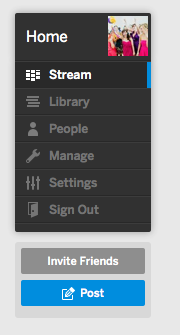
Your navigation box stays with you as you move around Myspace.
One of New Myspace’s major imperfections involves its privacy settings. The site offers little in the way of customizable privacy controls—though you can opt to have a private profile, where you must approve of your connections before they can view your entire page or see your activity. You can’t pick and choose what information you share with particular connections, either, apart from privatizing your music queue and deleting activity posts after they’re already live. It’s either all in or all out.
To post an update, click the blue Post button on the left. You have 150 characters to work with, and you can tag each post with a song, photo, or location. Tahmasbi said that the simple posting page encourages users to add multimedia content to their posts, not just words. Posts show up on your own profile page, as well as on the Streams of people who have connected to you. In fact, all of your activity around the site shows up on your profile—when you listen to a song, make a new connection, comment on a photo, or do anything in between, your connections will see what you’re up to. You can hide your music activity by switching your deck from Public to Private; and you can delete posts, which removes them both from your profile and from other users’ Streams.
To search the site, just start typing—Myspace doesn’t use a traditional search bar, so when typing anywhere on the screen other than in a designated posting box launches the Search tool. Results are sorted by type; you’ll see songs, artists, albums, people, mixes (playlists), and videos associated with your search term. Finding bands and strangers to connect to is a breeze, but there's no way to tell whether your real-life friends are on the site, except by searching for them one-by-one. Let's hope that, down the road, we'll have a way to find and connect with all of our overlapping Facebook, Twitter, or even Classic Myspace friends.
Search results are sorted into different categories.
Connecting with content
Connections are not just for discovering people. You can also connect to songs, photos, and other content. When you connect to content, Myspace adds it to your Library, where it is categorized by content type: Songs, Albums, Videos, Mixes, or Photos. It’s a handy way to keep track of content that you’ve discovered around Myspace and think you’ll want to visit again later.
If you come across a mix or album that you want to listen to (but may not want to add to your library), simply click the song to start playing it. The site adds tracks to your Queue in the deck at the bottom of the page; you can drag and drop tracks in any order to create a playlist. You can also add saved songs, albums, or mixes from your Library to your Queue. New Myspace also has a Pandora-like Radio feature that lets you listen to stations based on a specific genre or artist.
Another feature that debuts in New Myspace is the Mix, which involves more than just a series of songs. For example, if I wanted to make a Mix about my best friend, I could add photos of the two of us, our favorite songs, and video clips that make us laugh. You could also make a Mix of just photographs from a recent trip that you took, or a Mix of just songs and videos—it’s completely up to you.
Make a multimedia Mix to share with your connections.
Looking for suggestions about popular profiles or content to check out? Browse through the Discover page, which features trending stories and content from around Myspace. You’ll see newly released songs and music videos promoted here, along with collections of trending YouTube videos, photographs, and special-interest articles about other Myspace users. Check out songs that currently enjoy the highest rotation on Myspace, or mixes that have attracted a lot of interest.
A place for creative people
Above all, New Myspace is designed to be a mecca for creative people of all kinds. This has always been one of Myspace’s strong suits (for musicians, in particular), but New Myspace structures the artist presentation, content hosting, and sharing features inside a far cleaner, “designed” environment. Artists can use Myspace as a portfolio of sorts, and their fans can use it to follow artists they like and to keep abreast of fresh content and news updates.
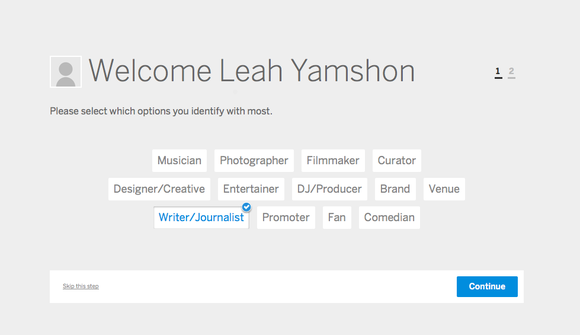
Who are you? Pick the creative type that you must identify with.
Originally, the Myspace team saw the new site as a launching platform mainly for musicians, according to Tahmasbi, and Classic Myspace did turn into a large music community. But New Myspace will try to provide homes for all sorts of artists, not just musicians. When you sign up and make your profile on the new site, you’re asked to select a template based on the creative label you identify most with; options include musician, photographer, artist, and writer, among others. Though the team anticipated a large music audience, a surprisingly large number of photographers were attracted to the site, too, so the developers decided to add some photo features to meet their needs.
“As we see more people on here, we’ll create different templates for different types of creatives,” Tahmasbi said.
Meanwhile, New Myspace still offers a lot for bands and solo musicians. Tahmasbi explained that Myspace has a standing arrangement with numerous major record labels that permits users to stream a wide variety of music. For now, users can stream unlimited amounts of music on the site ad-free, but ads may come in the future.
Unsigned bands can upload their own tracks to their profile and share them with their fans for extra exposure. The layout of a musician's page will differ from that of a traditional Myspace profile page; it’s a place to show music, videos, and events by the artist. You’ll also find links to similar artists, and to artists that the band lists as having influenced it.
A music page shows songs, videos, and events for the artist, plus other fans who have made connections.
Fans can also connect with other fans of an artist. New Myspace introduced a concept called Top Fans, which shows who interacts with a paticular artist the most. The coveted Top Fan spot is based on overall Myspace activity (how many connections a user has, how often the person posts, and so on) and on influence (how often the person shares information about the band with connections and how wide the person's reach is).
“Artists can see who their top recruiters and ambassadors are,” said Tahmasbi, “and it also adds a gamelike strategy for the fans.” If an artist announced plans to reward the Top Fan in some way, this would likely spark competition between fans who wanted to win.
Big picture: Will it stick?
As it stands, New Myspace offers a different user experience than you'd get at any other social network. It’s more inviting to exploration than Facebook, more interactive than Tumblr, and more emphatic than Google+. It’s clearly a major step up from Classic Myspace, and I would even go so far as to say that its music-streaming capabilities make it a competitor of other Web-only music-streaming sites, like Grooveshark. It may also challenge other band-hosting and music distribution sites like Bandcamp.
From a content discovery perspective, New Myspace has some real potential. Videos and photos shine in this format, and the Mixes feature is simply unavailable elsewhere.
Though many people may wonder whether New Myspace will surpass Facebook, that’s not the right question to ask. The two sites serve different purposes and different audiences. If the community continues to grow, and the developers continue to improve and enhance the site, Myspace may just come back around.
Wakil Sekretaris Jenderal DPP Partai Demokrat Nurhayati
Ali Assegaf meminta kepada semua pihak untuk menghormati sikap Ketua
Majelis Tinggi Demokrat Susilo Bambang Yudhoyono dalam penyelamatan Partai Demokrat. Pasalnya, menurut dia, SBY selaku Presiden sudah bekerja keras dalam delapan tahun terakhir.
Hormati Pak SBY sebagai
Presiden. Beliau selama ini sudah kerja keras. Ketika mengurus partai
yang didirikannya, berilah Beliau waktu
-- Nurhayati Assegaf
"Hormati
Pak SBY sebagai Presiden. Beliau selama ini sudah kerja keras. Ketika
mengurus partai yang didirikannya, berilah Beliau waktu," kata Nurhayati
di Gedung Kompleks Parlemen Senayan, Jakarta, Senin (11/2/2013).
Nurhayati mengatakan, semua pemimpin partai pasti akan melakukan hal yang sama jika partainya mengalami masalah. Dia yakin SBY tak akan melupakan segala hal yang menjadi tanggung jawabnya sebagai Presiden.
Ia
juga meminta kepada semua pihak untuk tidak mencampuri urusan internal,
apalagi membenturkan antarpetinggi Demokrat. Dia berharap, pihaknya
diberi waktu untuk menyelesaikan masalah internal.
"Biar masalah
internal jadi masalah internal. Beri kami ruang menata Demokrat untuk
kembali mendapat kepercayaan masyarakat," ujar Anggota Komisi I DPR itu.
Seperti diberitakan, berbagai pihak mengkritik SBY pascakeputusan Majelis Tinggi Demokrat dalam penyelamatan partai. SBY memutuskan mengambil alih Demokrat. Seluruh mekanisme di partai harus melalui Majelis Tinggi.
SBY
bertugas, berwenang, dan bertanggung jawab memimpin penyelamatan dan
konsolidasi Demokrat. Selain itu, segala keputusan dan tindakan Demokrat
ditentukan dan dijalankan Majelis Tinggi yang juga mengambil keputusan
dan arahan penting dan strategis.
Elemen-elemen partai berada
dalam kendali dan bertanggung jawab langsung kepada Majelis Tinggi.
Sikap SBY itu setelah rilis hasil survei Saiful Mujani Research and
Consulting (SMRC) yang menunjukkan elektabilitas Partai Demokrat tinggal
8,3 persen. Angka itu merupakan paling rendah pascapemilu 2009 .
SBY sudah membantah penilaian bahwa dirinya tak akan fokus dalam pemerintahan
hingga 2014 . "Saya pastikan kehadapan rakyat Indonesia, saya
tidak melalaikan tugas saya yang utama menjalankan roda pemerintahan dan
memimpin kehidupan bernegara," kata SBY.
The wait is over for Office 2013 and Office 365. Starting Tuesday, the latest version of Microsoft’s venerable productivity suite goes on sale to consumers and academics, both on Microsoft’sOffice.comsite and at retail outlets. You can buy the traditional stand-alone desktop software or, for the first time, consumers and students can buy Office as a subscription service that will make multiple installations cheaper.
Along with assorted new features and a design overhaul, Office 365 subscription services introduce the much-touted "Office on Demand" feature that allows subscribers to access full versions of Office applications on Web-connected PCs.
Windows users can still buy stand-alone versions of Office 2013 the old way (for prices ranging from $140 to $400). But if you need even the least-expensive edition on more than two or three computers in your household, you might wind up paying more than you would under the $100-a-year Office 365 Home Premium subscription plan (see our previous story on Office pricing), which covers up to five desktop installations (PC or Mac) versus a single installation for the stand-alone license.
Here's the Office 365 online hub.
For students, faculty members, and anyone else who qualifies for the Office 365 University license, the deal is even sweeter: Microsoft is charging a mere $80 for a four-year subscription that covers two desktop installations.
Note also that the subscription licenses give you all the major Office apps, including Outlook, Publisher, and Access. The $140 Home & Student desktop software does not include those three apps; the $220 Home & Business edition adds Outlook but not the other two. To get Outlook, Publisher, and Access as well as the core Word, Excel, PowerPoint, and OneNote programs as desktop software, you must pay $400 for Office 2013 Pro.
Click to zoom and view Office 2013: Your Buying Choices
Subscribers also get more SkyDrive storage space (20GB versus 5GB free) and 60 minutes each month of free Skype phone calls to 40 countries.
Businesses interested in the subscription service still have to wait: Microsoft says it will begin selling Office 365 Small Business Premium (which adds Microsoft’s Lync unified communications and InfoPath forms support) on February 27.
Streaming Office on Demand didn't work perfectly.
Office on Demand: More than a Web app, but not for everyone
Office 2013 has been available to IT pros, enterprises, and developers (read our review) since late last year, and the desktop software hasn’t changed in the meantime. (Microsoft has, however, posted system requirements.) But the Office 365 subscription services introduce new features such as Office on Demand for Web-connected PCs. We've heard no word from Microsoft on when Office on Demand for Android or iOS users might be available.
Office on Demand has some system requirements: Windows 7 or 8 and a supported browser, namely Internet Explorer 9 or later, Mozilla Firefox 12 or later, Apple Safari 5 or later, or Google Chrome 18 or later. If you can’t run Office on Demand, you probably can still edit documents in Microsoft’s Web apps, which aren’t as full-featured but can certainly handle basic chores.
Your Microsoft ID is central to the new Office experience.
Hands-on with Office on Demand
I tried Office on Demand by uninstalling Office completely on my laptop and setting up my Office 365 Home Premium subscription on Office.com. This process involves typing in a product key, much the way you would during the desktop-software installation, and linking it to a Microsoft account; I used my Windows Live account.
I then logged in via Office.com and immediately saw a My Office landing page that showed all my SkyDrive files as well as icons for accessing the on-demand apps: Word, Excel, PowerPoint, Access, and Publisher.
Clicking one of the application links first brings up a tooltip suggesting that you’ll be creating a new document, and then produces splash screens informing you that the application is being streamed to your browser (Google Chrome showed a pop-up with more detail about the add-on). The application took about a minute or so to launch—but when it did, it looked like the real deal.
Upgrading? Choose between 64-bit and 32-bit versions of Office.
Alternatively, you can click an existing document in SkyDrive and then click an Edit Document link, which gives you the choice of working in the Web app or accessing the full on-demand app.Regardless of how I opened a document, I noted a slight delay in saving to SkyDrive. At one point the app was unable to save to SkyDrive (it said it was disconnected from the server) and saved the document to my hard drive.
I also ran into an issue involving a conflict between a 64-bit installation of Office and a 32-bit version. Microsoft says an Office 365 license can cover a mix of 32- and 64-bit installations, but if you're upgrading from Office 2010, you cannot switch from the version of that installation. In other words, you can't upgrade the 32-bit version of Office 2010 to the 64-bit version of Office 365 and vice versa. If you don't have a previous version of Office installed, you can choose either version, but unless you frequently work with large data sets, Microsoft recommends using the 32-bit version, even if you're running a 64-bit version of Windows.
The cloud-connected Office 365 is potentially a game changer for Microsoft's Office franchise. In its current incarnation, however, Office on Demand doesn't offer the type of flexibility and consistency you'd hope for with a Web-friendly version of Office. We are also still eagerly awaiting versions of Office that will work with an Android tablet and an iPad mini; be sure to read more about the many faces of Office, including details about what you can and can't get on mobile devices.
If you’re like a lot of people, when it comes time to renew your security software, you may ask yourself, “Do I really need to upgrade to the latest version?” The answer is yes. Keeping up-to-date is generally a good idea, as new threats surface constantly. And if you value mobile security or use a social network, this year’s crop of security suites is worth paying attention to.
An increasing number of security suites now feature special tools to help protect you on social networks—a growing target for spammers, scammers, and other parties who want to get at your personal information. For example, Trend Micro’s Titanium Internet Security suite comes with a handy tool that highlights any possible areas of concern involving your Facebook privacy settings. Various suites also include tools that will scan links on social networks so that you aren’t duped into clicking a malicious link hidden behind a URL shortener.
If you own a smartphone or tablet, or both, the security class of 2013 has some new tools for you. And some security packages come with a mobile app that provides protection against mobile malware or includes other features such as GPS tracking to help you find your phone should it go missing. These apps often also include remote-wipe capabilities that let you delete the contents of a missing phone or tablet so your private data doesn’t end up falling into the wrong hands.
In addition, Windows 8 has changed the way security software makers design their programs. Many of the suites we looked at this year sport redesigned interfaces that include larger buttons and controls made to be more touch-friendly.
As usual, we teamed up with the fine folks at AV-Test, a respected antivirus testing lab based in Germany. AV-Test ran each suite through a comprehensive battery of tests to find out how well each would stand up to the worst malware currently in existence. AV-Test also performed speed testing to determine whether the suites will slow your PC to a crawl. We analyzed the data that AV-Test provided, and then tried each of the products ourselves to give you an idea of which suites you should go for—and which ones you should pass on.
Here are the suites we tested. You can click on each link to read individual reviews, or simply read this list for quick star ratings and summaries.
1. F-Secure Internet Security 2013 — 4.5 stars (Superior). F-Secure’s latest suite offers excellent protection and a friendly user interface.
2. Norton Internet Security 2013 — 4.5 stars (Superior). With its great detection rate and Windows 8-ready design, Norton’s suite is definitely worth a look.
3. Trend Micro Titanium Internet Security 2013 — 4.5 stars (Superior). This “titanium” suite earned high marks in almost all our detection tests, and it has a nice interface.
4. Bitdefender Internet Security 2013 — 4.5 stars (Superior). Bitdefender has a user-friendly interface that will appeal to people of all experience levels.
5. Kaspersky Internet Security 2013 — 4 stars (Very Good). Kaspersky lets both beginners and advanced users get the most out of its suite, and scored well in our tests.
6. McAfee Internet Security 2013 — 4 stars (Very Good). McAfee didn’t earn top marks, but it’s still a proficient, user-friendly antimalware program.
7. G Data InternetSecurity 2013 — 3.5 stars (Very Good). G Data has an effective suite, but installation is a hassle, with a settings panel that's more suited to advanced users.
8. AVG Internet Security 2013 — 3.5 stars (Very Good). AVG’s security program is perfectly respectable. But perfectly respectable just doesn’t cut it these days.
9. Avira Internet Security 2013 — 3.5 stars (Very Good). This suite is competent at detecting, disabling, and cleaning up malware, but its user interface is unfriendly.
BEST OVERALL: F-Secure Internet Security 2013 F-Secure's 2013 suite kept our test system free of malware and did a great job of cleaning up infections that made it onto our PC. It's speedy and well designed, too.
BEST PROTECTION: Trend Micro Titanium Internet Security 2013 This suite had the most well rounded protection of all the suites we looked at. It proved effective at keeping malware at bay and at cleaning up infected PCs.
BEST SPEED: Norton Internet Security The days of Norton being ridiculed as slow are long gone: Norton's newest suite had lightning-quick scan times, and its impact on overall PC performance was minimal.
BEST INTERFACE: Norton Internet Security We liked Norton's polished, easy-to-use interface and one-click installation process. It's also designed to be Windows 8-friendly.
A competitive field
The security software market is highly competitive and it showed in our test results. In our testing, no suite detected less than 97.8 percent of recent known malware samples, and blocked below around 94.4 percent of new malware in our "real-world" attack- blocking tests. False positives were also largely a non-issue. But if you look closely, there are still some notable differences.
We noticed a fairly wide difference in terms of ease of use between the suites we looked at. While some—like Norton and Trend Micro—were very user friendly and polished, others—like Avira and G Data—were less so and seemed to be designed with expert users in mind.
In the end, even the lower-ranked suites performed reasonably well, but simply didn't stand out enough to claim a higher ranking.
What you don't get in these suites
For the sake of this story, we looked at mainstream Internet security suites, but most security companies also sell more feature-complete "advanced" suites. These suites include products like Norton 360, Trend Micro Titanium Maximum Security, and AVG Premium Security.
For the most part, these advanced suites feature the same basic antivirus engine as the more basic suites, but will also include PC maintenance tools, online backup, additional parental controls and privacy controls, and more.
What comes in the more advanced packages compared to the more basic suites does very between manufacturers, though: Some include a mobile app with the basic suite, while others include it only in their advanced suites. In general, though, the basic suites contain just about everything you'll need to keep your PC protected.
Threats to watch for in 2013
(by Tony Bradley)
More sophisticated phishing Email and text messages that contain links to malicious websites will improve in quality to the point that they'll be virtually indistinguishable from legitimate communications. The messages will become more polished and professional—no more broken English and poor grammar.
Watering-hole attacks A drive-by download is a twist on the concept of browser-based attacks. In this sort of attack, cybercriminals post malicious content on a Web page, and then try to figure out some way to lure you to visit the website. If the PC you use to visit the website is vulnerable to the exploit used by the attack, malware is downloaded and the system is compromised. In 2013, though, attackers will continue to hone in with more precise attacks known as "watering hole" attacks. Rather than casting a wide net (as attackers do with drive-by downloads), the watering hole attack is more precise.
Data breaches In 2013, attackers will continue to target weak security on Internet-facing database systems to acquire thousands or millions of compromised records at once rather than going after individual users. Unfortunately, there isn't much you can do to prevent this sort of attack, but you can go on the defensive by being vigilant. Monitor your bank and credit card statements and report anything suspicious to your financial institution.
Note: Click on the chart image below to see a summary of our findings.
MANCHESTER —
Para pemain sepak bola termasuk orang-orang yang cerdas. Bahkan, mereka
memiliki kecepatan otak yang lebih baik daripada para akademisi.
Demikian hasil studi yang dilakukan Universitas Montreal.
Dalam
serial pengujian di tempat latihan, beberapa pemain Manchester United
diminta mengidentifikasi arah empat bola tenis yang bergerak cepat di
layar lebar dengan film tiga dimensi. Mereka juga harus mengabaikan
jebakan-jebakan yang mengacau.
Tes yang sama diberikan kepada
beberapa mahasiswa. Hasilnya, ternyata para pemain bola lebih cepat
mengenali arah bola daripada para mahasiswa.
Peneliti yakin, otak
para pemain secara fisik lebih tebal daripada otak para mahasiswa di
area-area tertentu. Ini yang membuat mereka memiliki kemampuan fokus
sangat bagus.
Pemimpin studi itu, Profesor Jocelyn Faubert, dari Universitas Montreal, seperti dilansir The Sun
mengatakan, "Ini menunjukkan bahwa atlet memiliki kemampuan fokus dalam
perhatian mereka untuk mempelajari sesuatu dengan cepat dan baik. Ini
kunci dari sebuah kemampuan."
Namun, ia masih belum bisa
menyimpulkan apakah para pemain bola memang dilahirkan dengan otak
supercepat atau ketebalan otak itu tumbuh karena proses aktivitias
mereka.
Rooney, misalnya, termasuk pemain yang memiliki kecepatan
otak yang tinggi. Dia juga pernah membuktikan kemampuannya itu dengan
memenangkan kuis bulan lalu bersama Jonny Evans dan Ryan Giggs.
KOMPAS.com
- Apple didapuk sebagai perusahaan paling inovatif pada tahun 2012,
menurut survei yang dilakukan oleh Booz & Company, sebuah perusahaan
konsultan manajemen yang berbasis di Amerika Serikat.
Hasil
dari survei yang dilakukan terhadap 1000 perusahaan itu dirilis dalam
laporan bertajuk “Global Innovation 1000 Reports”. Laporan tahunan itu
menyebutkan sejumlah perusahaan inovatif di seluruh dunia di sepanjang
2012.
Di bawah Apple, Google menempati posisi kedua perusahaan
paling inovatif, diikuti oleh 3M, Samsung, GE, Microsoft, Toyota,
P&G, IBM, dan Amazon.
Selain mendata perusahaan-perusahaan
yang inovatif, melalui survei itu Booz juga mempelajari bagaimana
perusahaan-perusahaan sukses bisa menciptakan beragam inovasi produk dan
jasa.
Menurut Businessinsider yang dikutip KompasTekno,
berikut adalah hal-hal yang dilakukan oleh perusahaan-perusahaan
inovatif, diantaranya adalah Apple dan Google, berdasarkan survei
tersebut:
Dalam perusahaan inovatif, semua orang adalah inovator.
Setiap karyawan dalam perusahaan ini dipercaya sebagai orang-orang yang
kreatif. Mereka dibuat merasa nyaman dengan lingkungan kerjanya,
dirangkul dan dihargai, serta diberikan kepercayaan untuk berinovasi.
Dengan menjaga kultur kreatif dalam lingkungan kerja, perusahaan bisa mengembangkan ide dan menciptakan produk-produk baru yang berguna.
Perusahaan inovatif mengukur kesuksesan ide mereka. Perusahaan menghitung berapa banyak ide yang akhirnya dieksekusi dan dikembangkan menjadi produk nyata.
Hasil
survei Booz cukup mengejutkan. Ternyata semakin kecil perusahaan,
semakin berani pula mereka mengeksekusi ide-idenya. Perusahaan kecil
memang memiliki jumlah karyawan lebih sedikit, namun lebih gesit dan tidak direpotkan oleh birokrasi.
Perusahaan inovatif banyak mengubah
idenya sebelum menjadikannya produk. Menciptakan inovasi tidak secepat
kedipan mata. Inovasi bukan hanya soal menemukan ide, tetapi juga soal
memilih mana ide yang benar-benar bagus.
Ada tahapan-tahapan yang perlu dilalui untuk mengeksekusi ide menjadi sebuah produk nyata. Riset, uji coba, serta mengumpulkan feedback dari konsumen adalah proses yang wajib dilalui.
Singkat
kata, perusahaan inovatif mengujikan ide-ide mereka kepada para
pelanggan, karyawan, serta partnernya. Inovasi yang sukses harus
menggabungkan hal-hal yang dicari oleh konsumen dengan hal yang
benar-benar baru.
Perusahaan inovatif memiliki satu orang yang
bertanggung jawab soal ide dan inovasi. Sergey Brin, misalnya, adalah
“raja ide” di Google. Dia bertanggung jawab atas proyek Google X, sebuah
fasilitas yang dibangun Google untuk melakukan riset dan mengembangkan
teknologi-teknologi masa depan.
Perusahaan inovatif mendapatkan ide dari mana saja,
baik dari internal maupun eksternal perusahaan. Perusahaan ini
“berbicara” dengan para pelanggan dan klien mereka, baik secara langsung
ataupun melalui survei yang dilakukan oleh firma riset yang mereka
sewa.
Perusahaan inovatif sadar bahwa inspirasi untuk menciptakan produk yang hebat hanya akan datang jika mereka betul-betul mengenal para pelanggannya.
Untuk menciptakan inovasi, mereka juga tidak menutup kemungkinan untuk
mengakuisisi perusahaan lain, memasuki pasar yang baru, atau menarik
orang-orang kreatif yang berjiwa entrepreneur.
Perusahaan
inovatif menciptakan ide melalui tiga cara. Mereka melakukan pendekatan
dan berbicara langsung dengan para konsumen, melakukan riset pasar,
serta memberikan kesempatan bagi para karyawannya untuk bereksperimen
dan menciptakan hal-hal baru.
Perusahaan inovatif berhati-hati dalam mengeluarkan dana
riset dan pengembangan (R&D). Kesepuluh perusahaan paling inovatif
yang telah disebutkan di atas bukanlah perusahaan-perusahaan yang
menggelontorkan uang paling banyak untuk mendanai program R&D
mereka.
Dari 10 perusahaan itu, hanya Toyota, Microsoft, dan
Samsung yang mengeluarkan banyak uang untuk program R&D. Bujet
R&D Samsung pada tahun 2012 senilai 9 miliar dollar AS, sebagai
informasi, hampir setara dengan gabungan bujet R&D dari Apple,
Google, dan 3M sebesar 9,2 miliar dollar AS.
Perusahaan inovatif
menciptakan ide-ide barunya secara sistematis. Perusahaan manapun bisa
mendapatkan ide-ide yang bagus. Tetapi, untuk mendapatkan ide cemerlang
secara terus-menerus, sebuah perusahaan perlu memiliki sistem yang mampu menghasilkan ide, memilih ide mana yang harus dieksekusi, dan mengumpulkan feedback untuk ide-ide tersebut.
Sistem
itu juga mampu memprediksi apakah produk yang baru bisa menarik
perhatian konsumen dan menjadi sebuah inovasi, serta mampu mengukur
kesuksesan dari inovasi yang telah dilakukan oleh perusahaan.


 7:33:00 PM